I haven't even heard of the new D3D12 feature-levels until now. It still seems the GCN-architecture was designed to be very future proof.
That means every GCN-based Radeon (GCN arrived in 2011 with the HD 7x00-series) will get a free upgrade (as long as D3D12 is used/patched to current and future games).
I see D3D12 as something developers have wanted for a long time. It basically smash the old reputation and limitations of the D3D API and allow developers to really fine tune and optimize their rendering engines.
Given that GCN doesn't feature bare-metal support for D3D feature-level 12_1, its implementation will be as limited as feature-level 11_1 was, when NVIDIA's Kepler didn't support it. This is compounded by the fact that GCN is a more popular GPU architecture than Maxwell (which supports 12_1), thanks to new-generation game consoles. It could explain why NVIDIA dedicated three-fourths of its GeForce GTX 980 Ti press-deck to talking about the features of D3D 12_1 at length. The company probably wants to make a few new effects that rely on D3D 12_1 part of GameWorks, and deflect accusations of exclusivity to the competition (AMD) not supporting certain API features, which are open to them. Granted, AMD GPUs, and modern game consoles such as the Xbox One and PlayStation 4 don't support GameWorks, but that didn't stop big game devs from implementing them.
Given that GCN doesn't feature bare-metal support for D3D feature-level 12_1, its implementation will be as limited as feature-level 11_1 was, when NVIDIA's Kepler didn't support it. This is compounded by the fact that GCN is a more popular GPU architecture than Maxwell (which supports 12_1), thanks to new-generation game consoles. It could explain why NVIDIA dedicated three-fourths of its GeForce GTX 980 Ti press-deck to talking about the features of D3D 12_1 at length. The company probably wants to make a few new effects that rely on D3D 12_1 part of GameWorks, and deflect accusations of exclusivity to the competition (AMD) not supporting certain API features, which are open to them. Granted, AMD GPUs, and modern game consoles such as the Xbox One and PlayStation 4 don't support GameWorks, but that didn't stop big game devs from implementing them.
Yup
Main PC : I7 12700, MSI Ventus RTX 4090 24gb, Alienware AW3423DW QD-OLED
Laptop : I5 4200H @ 3400mhz boost, GTX 850m 2gb Vram DDR3, 4gb RAM DDR3
Derpsole : Playstation 5 disc edition, Ninty Switcherino
TV+audio: LG CX 65" / Sonos ARC + SL ones + Sonos sub 3
VR Headset: Meta quest 2 airlinked
AMD does not support Volume Tiled Resources because they weren't a thing when they released even the 290X - we'll just ignore the fact that they were the ones who did tiled resources to begin with, before they even made it into DX11. And of the other 2 features in 12_1, one is supported in hardware and the other can be emulated via the geometry shaders (so they do support those features). They have never made the claim that those features were "irrelevant" - unlike Nvidia, who claimed all the shit they didn't support in 11.0 and 11.1 was "irrelevant". Funny how they now implemented that stuff anyway. Reminds me of how useless display spanning was according to them when AMD first did it.
Meanwhile, tiled resources are emulated on Nvidia except on Maxwell "2" (GM20x), same for conservative depth, and their resource bindings are limited pools (which are unlimited on all GCN cards all the way back to 2012).
These days, i just come to this thread just because russ80, cant wait for hes response ... Come on, give something (29 days remaining of my summer vacation)!
is it fair to say it will be a while before DX12 games will be out and how GCN cards will fare practicly in DX12 with those games? I for one bought my 7870 2 years ago as a DX11 card and never expected it to run any kind of DX12. so im not disappointed at all. AMD will have complete new line up from low end to high end early next year so i assume those will be full fledged DX12 in time for the first DX12 games if they dont arrive this november ( new deus ex? )
The company probably wants to make a few new effects that rely on D3D 12_1 part of GameWorks, and deflect accusations of exclusivity to the competition (AMD) not supporting certain API features, which are open to them. Granted, AMD GPUs, and modern game consoles such as the Xbox One and PlayStation 4 don't support GameWorks, but that didn't stop big game devs from implementing them.
GameWorks is yet another proprietary nVidia "thing" just like PhysX where they deliver DLL's instead of source code. Shenanigans from nVidia as usual.
is it fair to say it will be a while before DX12 games will be out and how GCN cards will fare practicly in DX12 with those games? I for one bought my 7870 2 years ago as a DX11 card and never expected it to run any kind of DX12. so im not disappointed at all. AMD will have complete new line up from low end to high end early next year so i assume those will be full fledged DX12 in time for the first DX12 games if they dont arrive this november ( new deus ex? )
No. It will be much quicker than that. DX12 is full of shit that developers have been dying to get on the PC for years.
And your 7870 is fully DX12 compatible. It doesn't support 2 features that were added 2 months ago, but everything else is supported. And it does support some optional features that Nvidia still doesn't support even on GM20x.
Don't expect to see much of DX12 in final retail game form this year. Maybe we'll see a few DX12 updates for older games but that's about it. Also, people need to have realistic expectations, for example Project Cars devs claim 30-40% performance increase in certain scenarios and configurations. People salivating over these almost irrelevant 3DMark's draw calls need to chill out and get real, we won't see 800-1000% performance increase in actual games.
Scaling is somewhat bad throughout, except for Tomb Raider which gives you almost perfect 200% scaling apparently (I bet it's because it's an AMD game ).
My guess is what we are seeing is games hitting the bottlenecks that are not GPU power related. With higher resolutions the effect of GPU horsepower becomes more relevant.
This is kinda ties into the DX12 subject - what we should hope to see from DX12 is less games that run like crap while your GPU is underutilised. Almost every recent game suffered from it, especially larger scale open-world ones.
I would like to know what happens if you disable AA at 4K. My next will be a 4K (my seating distance is closer to a desk-monitor scenario, than couch-tv). It seems like it will be some time, before 60fps at 4K is affordable to me.
Yes it does. But no, being CPU bound does not necessarily mean 100% CPU usage.
If the GPU can render a frame in say, 2ms, that means the CPU has to be able to submit the next frame within 2ms. When it is unable to do so, you're CPU bound and that's what happens when you use 2 GPUs like that. 1080p is not an issue for one of those, let alone 2 of them.
But why then would a monster like the 5930K not be capable of submitting that data in time?
Say hello to the reason why Mantle, Vulkan and DX12 exist: overhead.
It's not at 100% CPU usage, not by a long shot. What happens is just DirectX 11 overhead. When the programmer sends a command to D3D, that command is then analysed and validated within DX11. Then it gets sent to the driver, which does its own sanitisation as well as "translating" it to and optimising for the architecture it's running on. So where the programmer may have sent a single instruction, D3D internally might've executed another 20 and the driver another 10. Each instruction takes up at least (!) 1 CPU cycle, so you can see how that quickly adds up.
What's more annoying is that D3D is not very optimised for multithreaded use; so even though that thing has 12 threads, all the rendering shit will only be happening on 2 or 3 of those threads.
Last piece of the puzzle is the fact that there's some shit that actually requires multiple sequential steps. So you need to run something that gets sent to the GPU and you have to wait for the result to come back so you can continue with something else. So taking the example above, you've just wasted 31 cycles to send that, then you gotta wait for the response to come (which uses another bunch of CPU cycles while it passes through the driver and D3D) and then you repeat the whole process again. Obviously even with low overhead, the roundtrip time is painful so developers avoid this at all costs, but there are situations where it can't be avoided.
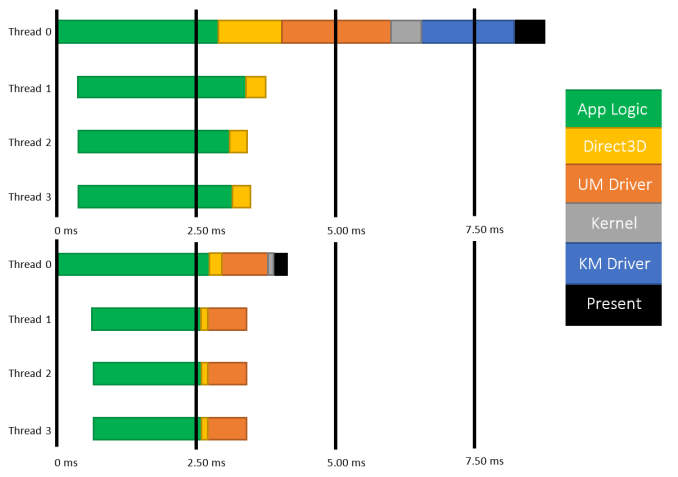
Here's an image to illustrate how bad this shit gets:
Look at the very top one. Game spends just over 2.5ms running some code, but then there's basically another 5ms of crap incurred by all the overhead. That is how bad it can get.
Also, SLI and Crossfire "shift" the chance of a bottleneck towards the CPU because while you have 2 GPUs working independently on frames, there is only one CPU to supply frames for both of them. Which means the CPU needs to get those frames in half the time it takes a GPU to render it to achieve proper scaling.
Signature/Avatar nuking: none (can be changed in your profile)
You cannot post new topics in this forum You cannot reply to topics in this forum You cannot edit your posts in this forum You cannot delete your posts in this forum You cannot vote in polls in this forum



 ... Come on, give something (29 days remaining of my summer vacation)!




 ).